
If April showers bring May flowers, then the annual deluge of autumn and end-of-year surveys yields a bumper crop of spring data ripe for analysis. This spring is no different than others, but the complexities of the past year pose some challenges extricating takeaways, in no small part because data from fiscal year 2020 straddled the end of a normal fundraising year in 2019 and the onset of the COVID-19 pandemic in spring 2020.

According to Blackbaud’s 2020 Charitable Giving Report, last year was a transformational and remarkable year despite a universal drop in charitable giving in April, May, and June 2020. Overall, U.S. charitable giving grew 2% over 2019. Unsurprisingly, thanks to the pandemic, online giving grew by nearly 21%, with a record 13% of all fundraising coming from online sources. Of those online donations, nearly 30% were made from a mobile device.
Zeroing in on giving from private sources to higher education, the CASE Voluntary Support of Education Survey reported roughly flat figures compared to the previous year ($49.5 billion in FY20 vs. $49.6 billion in FY19). Among respondents, nearly half (48.6%) reported an increase in giving. Community colleges fared slightly worse than the national aggregate, posting an almost 5% decline.
Among alumni, corporations, foundations, other individuals, and other organizations, only other organizations and other individuals posted increases in giving (7% and 4%, respectively). Of note is the fact that donor-advised funds represent nearly 74% of funds contributed to the “other organizations” category and have grown an incredible 53.2% over the last decade. All other giving sources posted reduced giving in the aggregate.
Data from fiscal year 2021 has only just started to trickle in, and the results are a mixed bag at best. According to a recent EAB survey of 104 advancement shops, 54% noted a decline in fundraising revenues in the first half of FY21; 25% saw a 30% or greater decline. Much of that decline was attributed to major gift activity—a trend that seemed to indicate more of a hesitation on the part of donors to commit due to the pandemic’s persistence and market volatility and not a reflection on the performance of gift officers and fundraisers.
One-third of institutions actually reported an increase in total dollars raised by at least 10%, despite a reduced pool of donors, and the median public institution grew fundraising dollars by 3%. However, this may simply reflect a few high-profile, transformative gifts that have been realized in the first half of FY21 (e.g., MacKenzie Scott’s donations).
That’s a lot of data. Now what?
Online/Mobile Giving
No one can deny the steady growth of online and mobile giving—a trend accentuated by the pandemic and unlikely to fall back to previous levels. Advancement shops would do well to carefully examine their online and mobile engagement strategies and the experience donors encounter through those platforms. Which donor segments are most likely to give online or through a mobile device? How do those donor segments align with the makeup of your donors? Are there gaps that may indicate a weakness in your engagement and/or fundraising strategy?
Donor-Advised Funds
If you haven’t had a brush with a DAF yet, it’s likely only a matter of time. If you’re not familiar with them or how they differ from family foundations, here are a few resources that can help get you up to speed:
What’s the Deal with Donor-Advised Funds?
Understanding Donor-Advised Funds and Family Foundations
Giving USA Special Report on Donor Advised Funds
Alumni Relations
According to the VSE Survey, “other individuals” is the category that holds the largest sway among community colleges in regard to giving from private sources (30%). The question of “other individuals” comes directly to bear in the perennial conversation on the value of engaging community college alumni and whether community college alumni give.
One of the challenges community colleges face here is a matter of definition. If you take eight community colleges from the eight CASE Districts in North America, you will likely find eight different definitions of what constitutes alumni at each college. According to the definition outlined by the CASE Alumni Engagement Metrics Task Force, alumni are graduates of the institution and others with a prior academic relationship, including non-graduates, certificate and credential holders, distance learners, lifelong learners, residents, post-docs, honorary degree recipients, and honorary alumni.
Consider the following two charts:
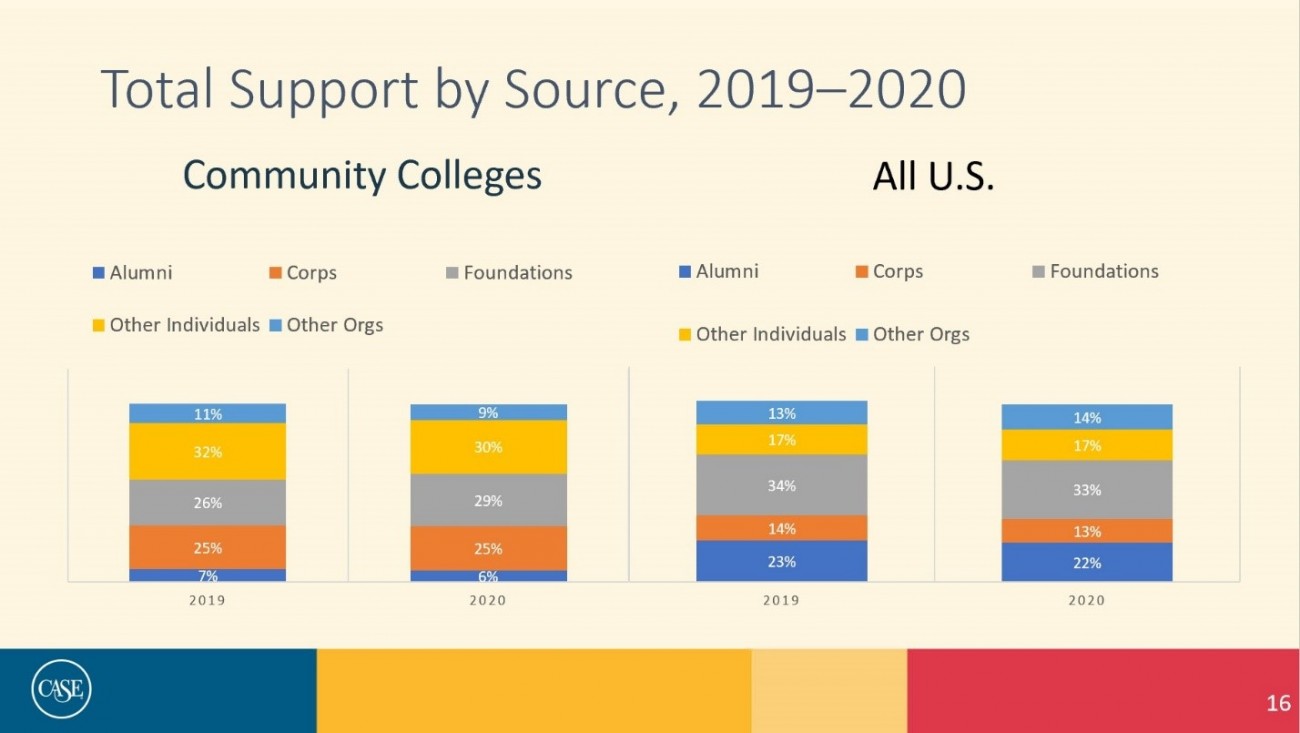
Look at the combined numbers of alumni and other individuals for community colleges as a share of total support by source (39% in 2019, 36% in 2020). Now do the same for all U.S. (40% in 2019, 39% in 2020). Suddenly—at least in terms of these two combined sources—these two pictures look strikingly similar. I propose that, contrary to the pervasive (and incorrect) assumption that “community college alumni just don’t give,” if defined according to CASE’s definition, we would see a very similar pattern of alumni giving between two-year and four-year institutions.
Data and Benchmarking
In this time of extreme variability in terms of fundraising performance and market volatility, there has never been a greater need for quality data and benchmarking, whether on a national, regional, state, or even institutional level. We need that data to accurately track performance, identify strengths and weaknesses, and make informed, strategic decisions to guide future efforts.
CASE offers two solutions to help you identify your peers—both current and aspirational—and benchmark against them:
The Voluntary Support of Education Survey is the authoritative source of data on charitable giving to educational institutions in the U.S. Every participant in this survey gains access to the Data Miner benchmarking platform and receives a Graphical Program Summary Report that provides a visual representation of your fundraising trends—not only in comparison with a cohort of 10 peers based on multiple core data points but also against all higher education institutions that complete the survey.
The College and University Foundation Survey provides a different angle by collecting data on foundation structure, staffing, and operations. Participants in this survey gain access to an exclusive benchmarking platform that allows them to compare their funding and operations with their peers, pull comparison data at any time, choose specific foundations to benchmark against, and learn about the latest trends in foundation management and operations. Participants also receive a slide deck outlining key trends from the previous fiscal year.
Far too many of us have had to respond to leadership who have pitted our institutions or foundations against others simply due to name recognition, geographical proximity, or reputation. We must proactively take control of that narrative and equip ourselves with data that clearly identify who our peer institutions are at a local and national level.