

Equity Q&A: Kerrien Suarez
In terms of organizational and institutional progress related to race equity, Kerrien Suarez sees as many reasons to be hopeful as to be discouraged. Suarez is the executive director of Equity in the Center, a Washington, D.C.-based organization that assists non-profit and philanthropic organizations on their journeys from “Awake to Woke to Work.”
What is Equity Q&A's:
- Jan Abernathy
- Christina Chang
- Paul Pribbenow
- Kerrien Suarez
“More people than ever understand what anti-racism and race equity are,” she says. “Yet and still, the overwhelming majority of people still have no idea what those terms mean or how they are different from diversity and inclusion.”
Suarez spoke to CASE’s Currents magazine for the “What is Equity?” feature story, but there wasn’t space to dig into some of the aspects of equity work that she discussed. What follows is an extended Q&A that has been edited for clarity and brevity.
In your experience, do you remember the term equity replacing equality as a buzzword in education?
Well, the words equity, equality, diversity, and inclusion are completely distinct words with different definitions. Equity is not a replacement for equality or for diversity. It’s something entirely different. One of the huge challenges with equity work is when folks use diversity and DEI as replacements for one another.
If someone speaks to you about being focused on equality, do you get worried?
I’m going to be honest and say this is my opinion, and it’s the opinion of Equity in the Center: Equity is the only term that should be used to frame your work to eliminate identity-based disparities, full stop.
If you are in an organization that is using the term equality, that term is outdated and insufficient. It’s insufficient just like diversity and inclusion are insufficient to drive equity. To yield equity in a society or in an organization, in a school, in an advancement office, requires a total transformation of policy, process, and culture to center equity. That’s the only way you yield different outcomes.
When communicating with clients or other organizations, do you find that people have similar notions of equity?
An increasing number are using the term equity. A significant portion, and I would say the majority, do not actually understand what equity is. They’re using the word equity because they heard that’s what you’re supposed to be using now.
Equity is more fashionable. It’s trendy. But, based on my experience, the majority of them don’t know what it means. Nor do they understand what diversity and inclusion mean. They’ve shifted their language because the ground has shifted in the past year, and even before that.
For the most part, people don’t know what they are talking about and are often part of a dialogue, but are having a completely different conversation than other participants (because they do not have a shared definition of equity). And what people do for years is launch DEI initiatives without ever defining what it is they are doing. It inherently minimizes the effectiveness of the initiatives, because everyone isn’t oriented toward the same goal.
The way people approach work around race and racism is different than how they approach any other sort of work in a business context. If you’re making widgets, if you’re managing a strategic planning initiative, if you’re doing some sort of change management initiative, the specificity of goals and the necessity of a timeline and a shared language is common sense and basic business procedure—on every concept but race, because we are socialized not to discuss race and are both deeply uncomfortable and ill equipped to navigate the subject.
So, they usually need to engage a consultant to support them. Otherwise, we’re not changing our culture, our policies, our processes. We’re not changing the power structure. We’re not exploring how white supremacy and white-dominant culture manifest in society or in organizations. We’re not socialized to do so because that would disrupt the status quo.
Are there reasons to be hopeful, given the increased energy that institutions and organizations are putting behind this work?
I think so. People’s hands have been forced because of quarantine and sitting at home and having to watch a Black man being suffocated, essentially on live television. The difference is not that George Floyd was murdered. It was that, when he was murdered, so many were stuck at home watching and had to think about what had happened and what it said about our society that a murder in broad daylight could occur at the hands of law enforcement.
I think something is different. But the majority of people are still not approaching shifting organizational culture with the framing of race equity and anti-racism that is required to drive transformation, even if they’re using those words now.
Anti-racism is a daily, hourly choice to dismantle white supremacy in your life and work and not be complicit. If you are not actively choosing to be anti-racist, you are upholding white supremacy. All you have to do to uphold racism is nothing, is to be unaware. That’s how the system operates.
Lots of calls I got last summer and fall were around the unrest inside of organizations that was happening. Because the company released a statement about racial justice when they have absolutely no idea what those words mean and don’t live them on a daily basis. The hypocrisy forced organizations to hire trainers, hire consultants. They’re being held accountable. More organizations than ever are beginning to orient themselves to make progress on those goals. Yet, this isn’t about holding a couple of trainings. It’s about committing to a process that will never end.
Can an institution begin internal and external equity work at the same time?
It is a balance. One of the big pitfalls of this work is that organizations do all this external work—and these public statements are the best examples of it. “I’m going to give away scholarships. I’m going to engage the community. I’m going to engage stakeholders. I’m going to go out and try to “include” all of these people who I won’t hire or give power to in my organization.” Even if people say they’re working on equity and anti-racism, because they are still in a DEI mindset, that’s the first thing they will go to do: something external.
At the earliest stages, you should be focused on internal transformation. At the beginning of the work, people will start to do the external stuff, because it’s easier. “Let me put all this stuff out into the world rather than turn the mirror on myself to examine the white supremacy and structural racism that is rampant in my organization.” When you change your institution internally, the external work follows as a natural extension of the transformation your internal work drives.
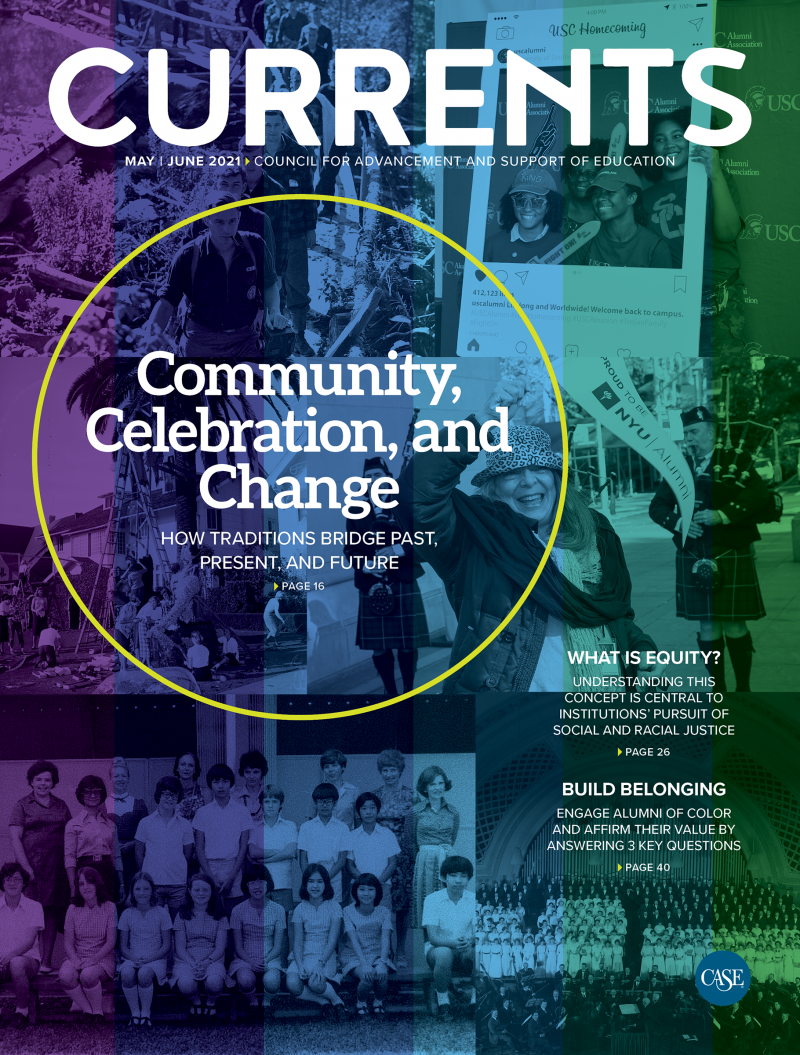
May - June 2021
Community, Celebration, and Change: How traditions bridge past, present, and future. Plus, understanding how equity is central to institutions’ pursuit of social and racial justice, engaging alumni of color, and investing in alumni during trying times.