

Equity Q&A: Christina Chang
Christina Chang is a talent management expert who spent more than 15 years at the University of Washington in Seattle before founding Christina Chang Equity Consulting. She works with higher education institutions on improving cultures of belonging, diversity, equity, and inclusion.
What is Equity Q&A's:
- Jan Abernathy
- Christina Chang
- Paul Pribbenow
- Kerrien Suarez
“Without context and history, you can’t even start the conversation about what is fair,” she says. “Because this is all about fairness.”
Chang spoke to CASE’s Currents magazine for the “What is Equity?” feature story, but had more insight to share than could fit in that article. What follows is an extended Q&A that has been edited for clarity and brevity.
When communicating with clients, do you find that people have similar notions of equity?
No, I think people haven’t thought of it. They have not sat down and actually thought about what the words actually mean. Some have never seen the side-by-side comparison [equity vs. equality]. I will get phone calls [from people] who think I’m a stockbroker because my organization has the work equity in it!
Have you seen greater understanding over the past year?
People aren’t talking about equity. It’s buzzwords. “We care about diversity. We want to be diverse.” With DEI, there’s a lot of jargon. Some people are saying they’re creating anti-racist cultures—because [author and professor] Ibram X. Kendi is everywhere, but I don’t often hear people talking about creating equitable spaces or equitable cultures.
My curiosity about that is, OK, a lot of people woke up [following George Floyd’s murder]. You know what? Better late than never. But racism and white supremacy have been going a long time. We’re not going to solve it in our lifetimes. I think it’s great that people are waking up. January 6 was another wakeup call for some people.
I hope it’s not just another performative thing and people are going to get complacent because the “right” president was elected.
You’ve worked with both private and public institutions. Do you think a private institution has different ideas related to equity compared to a public one (or vice-versa)?
Neither of them is doing this well. I don’t think either are doing enough.
I think that public institutions would like to think they are more “woke” because it’s a public good. A lot of publics think they’ve checked the box of already working on equity. But as we know and as we can see, there’s plenty of white supremacy culture to go around.
In terms of recruiting diverse populations, privates are doing a better job, because they can. They can be very targeted, whereas publics, whether as an excuse or [because they are] legally bound, they can’t at least openly recruit diverse populations.
Look up all the chief diversity officers at universities, public and private. It’s a revolving door. Does this position have a budget, a staff? Or is it a staff of one? What happens is organizations think, “Well we’ve hired a CDO, give it to them. We’ve handled this.” And that’s not the way this works!
How does equity specifically pertain to advancement? What can CASE members do in terms of how equity engages with fundraising, alumni relations, marketing and communications, or advancement services?
You don’t carve out DEI and put it in a corner. It has to be in all four pillars of advancement. The challenges are how to laminate it across all areas and how to sustain it…no matter who is in charge.
I see a pattern of leadership who cares about this work coming in and looking to make a big impact. But then they leave. And when they leave, it hasn’t been embedded. It’s still transactional.
Really, DEI is about culture. It’s about creating a culture where everyone can belong. It’s about embedding the work; it’s not just about tactics. Even a bigot would have to comply by those rules. I can’t care about what’s in your heart, because only you can change that. I know that you’re going to do what has to be done, because it’s in the system now.
Another issue is, OK, we care about diversity. We understand that it’s important. “But I’ve got to close this gift now and my donors are about 70% white.”
It’s a question of pay me now or pay me later. Advancement has always been an industry that understands the paradox of now or 20 years from now. If we know that by 2045, the U.S. is not going to be a majority white country anymore, then why are we not doing the work of preparing for that day? If these institutions want to be around and relevant, we need to understand where the demographics are going.
Those students are going to be the alumni of tomorrow. And we hope they are donors. And we’re just not prepared for that. Even though universities are doing a good job of recruiting kids of color, the faculty remains overwhelmingly white and advancement professionals are overwhelmingly white.
We in advancement are doing worse than faculty. Faculty is more diverse than advancement staff are (which is saying a lot, because faculty across the country are not a diverse bunch). We have a lot of work to do.
There’s a perception that statements around DEI can be hollow. How do you get beyond words?
White supremacy culture intellectualizes the problem and doesn’t connect it with one’s heart. One must develop empathy, or real change will be difficult.
We think we’re so intellectual, but we don’t know our history. When we don’t understand our history, how are we going to understand structural racism?
If you don’t know yourself, forget about having an authentic cross-cultural relationship with other people. If you can’t understand how you’ve been socialized, you can’t understand how to have an authentic relationship with someone who is different from you.
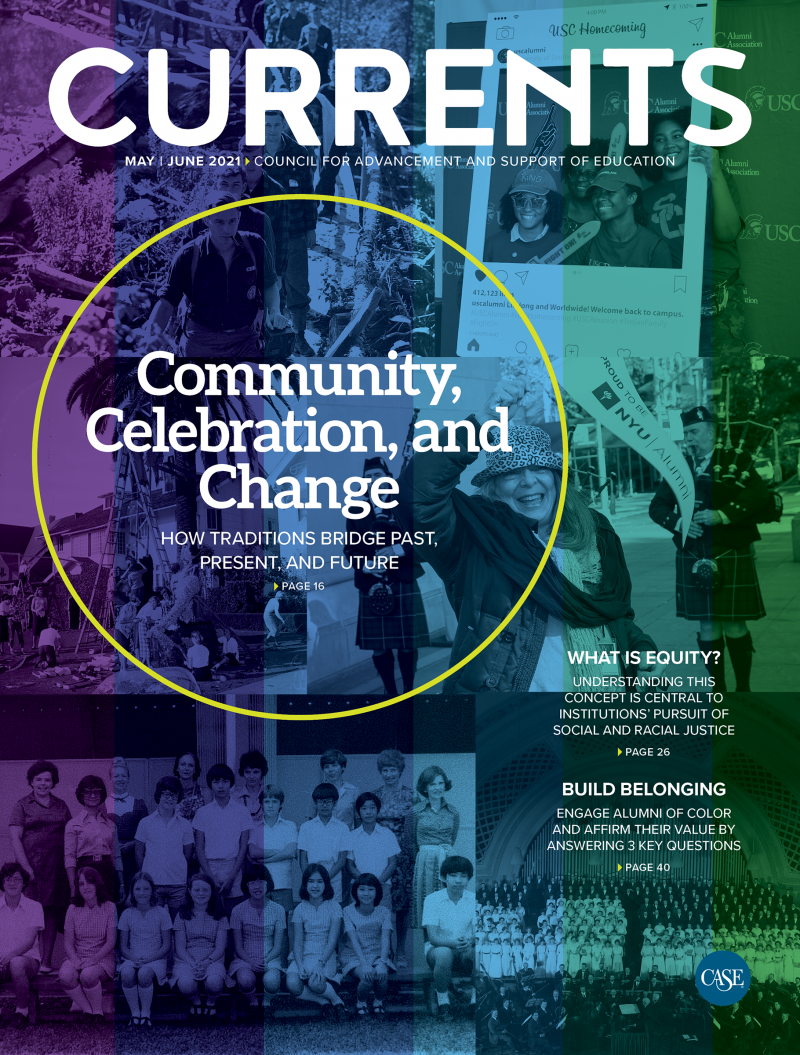
May - June 2021
Community, Celebration, and Change: How traditions bridge past, present, and future. Plus, understanding how equity is central to institutions’ pursuit of social and racial justice, engaging alumni of color, and investing in alumni during trying times.