
I’m guessing you, like me, tend to focus on the one negative thing someone said about you rather than all the good stuff. When I was an English instructor at Brookdale Community College, Lincroft, New Jersey, U.S., I would read every evaluation and dwell on that one jerk—I mean student—who would write something against my teaching style. I taught thousands of students over 13 years and had an excellent reputation—some students signed up for all the classes I taught—but it was the negatives I took to heart. I’ve heard this is called negativity bias, and according to PositivePsychology, it’s actually an “evolutionary mechanism where negative experiences have a more significant impact on survival” leading most humans to “be more sensitive to negative info as a form of self-protection.” Hey, that makes sense!
But as I review dozens of positive evaluations from the 2025 CASE Conference for Community College Advancement, I’m focusing on one negative: we didn’t offer sessions specifically about alumni fundraising. The planning committee knew this when we reviewed the 57 proposals. We were hoping for them! But they weren’t there. Several sessions, like “How to Advance Student and Alumni Success through Cross-Divisional Collaboration” from our terrific colleagues at South Carolina’s York Technical College (U.S.), touched on ways to connect with community college alumni, but it wasn’t enough. And there are a few reasons why—in our organization so proud of our Copy And Share Everything unofficial motto—it’s difficult for your colleagues to share info about alumni fundraising.
Since 2024, I’ve asked our Community College Leadership Committee and many other volunteers to present webinars—maybe even a webinar series—on alumni fundraising. A year ago, we ran “Strategic Alumni Fundraising for Community Colleges” thanks to CCLC members John Wolfkill from the Community College of Aurora Foundation (Colorado, U.S.), Chris Downing from Heartland Community College (Normal, Illinois, U.S.), Dutchess Community College’s Diana Pollard (New York, U.S.), and Allison Dolan-Wilson from Northern Essex Community College (Massachusetts, U.S.). It provided some excellent ideas, but that’s it for our programming. Why?
I think it’s because few community college advancement professionals feel they are experts when it comes to alumni giving. Each school has some ideas that work for them (see article in Currents magazine regarding Westchester Community College, U.S.) because they are doing the right thing—tailoring outreach and engagement to their specific alumni characteristics. But staffing is limited, and what works for one community college may not work for another.
While some of your presidents, foundation board members, and those new to community college advancement may say, “Just do what the four-years do!,” those of us who have been in this part of higher education fundraising for decades know it’s not that simple. Yes, those who attend and graduate from our schools are extraordinarily grateful for helping them find their way. Our students and graduates tend to stay in our communities because, well, they never left! But how much do our advancement offices invest in graduates, non-credit students, certificate earners? They typically attend our community colleges because of the low cost—so are they capable of making contributions that are worth our valuable and limited staff time and energy? That’s the big question, and the answer comes down to how well you know your former students, what kind of impact your school makes on your community, and how much your institution can invest in the necessary staffing.
According to our recent survey of a variety of successful U.S. community colleges, a lack of funds to hire advancement staff is the greatest challenge to growth. Some community colleges have an alumni relations manager who isn’t a member the advancement team making sure current students know how to eventually support the school through time, talent, and/or treasure. That’s helpful, but I hear more often that alumni relations managers’ responsibilities focus on career connections, mentoring, and alumni networking events, not specifically fundraising.
So should you focus your resources on securing what may be a lot of little alumni gifts, hire a part-time prospect researcher to help you find alumni who could make big gifts (Dutchess Community College does this), or stick with your closest prospects who have the ability to make a major gift—local philanthropists who love your school and companies who know you and your students and graduates well?
According to the 2024 CASE Voluntary Support of Education survey, community college advancement offices are choosing that last path because, at least for now, under your current staffing situations, that’s where the ROI is. Take a look at this:
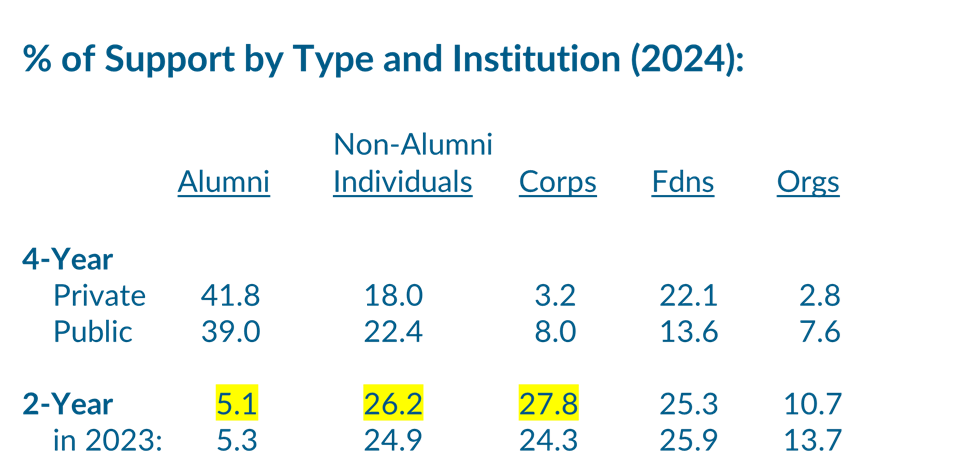
Whenever I share this data with CASE members, I hear, “I feel so much better! I thought we were the only ones not focusing on alumni!” You are not alone. More importantly, community colleges should not lose the advantage they have over the four-year schools regarding corporate giving. Look at those numbers! Show your president and board that chart and perhaps the four-year comparison will turn to, “Wow—they may be doing well with alumni giving but look at corporate and non-alumni giving for community colleges! Let’s keep building those relationships!”
Of course, alumni giving should be part of your comprehensive strategic fundraising plan, especially if you are in campaign mode. And, of course, I will continue to look for presenters for our conferences and webinars to share their success with alumni giving. I should note that the CASE Insights on Alumni Engagement report provides very helpful information regarding how to connect with students now and after they leave your campus. Look closely, though, and you’ll see that only a few community colleges completed the survey, and I think, after reading this column, you’ll understand why. (Click here for the report and details—the deadline to participate in the fiscal year 2025 survey is Jan. 16.)
Community colleges can learn a lot about alumni engagement from our four-year colleagues whose institutions, in many cases, have been operating for more than 100 years. But community colleges are trying, and must try, new approaches because your alumni are different. Soon, as more ideas prove to be successful (and, hopefully, as more community colleges have funding available to hire advancement staff who could focus on alumni giving), CASE will offer more conference sessions and webinars on best practices. We’re here to celebrate the wins and help you share what you’ve learned with your colleagues across the United States and the world.
After all, the heart of this discussion isn’t about what community college advancement lacks—it’s about what makes it distinct. Alumni fundraising looks different because your colleges serve a different kind of mission and a different kind of student. And that’s more than okay. It’s the clearest reflection of who you are and the communities you serve.