A Sense of Wonder: The New Workplace Superpower
As the Head of School at the Taipei American School, David Frankenberg naturally views things through the eyes of children. So, on the topic of curiosity, he recalls an image of his own child, maybe at the age of two, “emerging from the sea with a shell—looking at it with wonder and questions and openness and exploration.”
Also in This Story:
He believes we are all born with a natural tendency to be curious. As the leader of a K–12 international school, he encourages his students, and even his staff, to “take a beginner’s mindset to learning. I think that is what allows you to open yourself up and grow. All you want as a teacher is for a student to walk into a classroom full of questions and open to learning, even if that means making mistakes.”
That can be a challenge though, he says, for those in the business of education.
“We’ve established intelligence as the amount of knowledge that you have. I think asking questions is oftentimes viewed as not being excellent or not understanding. As students enter upper grades and are focused on college, grades become more important, and they begin looking at education through the lens of competition.”
Dawn Lees works with college students, especially those nearing graduation. Like Frankenberg, she believes grades can stifle curiosity.
“Magic happens when you don’t assess students,” she says.
Lees is Student Employability and Development Manager at the University of Exeter, U.K. She and her team are focused on preparing students for the modern workplace. That means providing opportunities outside the classroom where students have safe spaces to ignite their curiosity by taking risks and making mistakes—activities that encourage “blue-sky thinking,” like the university’s Grand Challenges week in which students brainstorm solutions to 21st-century problems on interdisciplinary teams.
Lees focuses on preparing students for a workplace in which soft skills are the key to success.
“They are crucial, especially with the advent of artificial intelligence. What are the human-only skills that people bring to a role? Creativity, analytical thinking, resilience, flexibility, emotional intelligence—things a machine can’t do. Employers are looking for these attributes. They can teach the technical skills, but they can’t teach you how to be you,” says Lees. “Today’s graduates will have far more jobs in their careers than previous generations. They will need to be adaptable to change. They will need to be curious.”
Frankenberg believes that more than half the jobs his students will have in the years to come “have not been invented yet. How do you prepare young people for an uncertain future? That doesn’t come by giving them information. It comes from teaching them the kind of skills that position them to transfer to different environments—to adapt, learn, and collaborate. As educators we must wholeheartedly embrace a paradigm shift toward the development of soft skills.”
And chief among those skills, he says, is rekindling our innate sense of curiosity.
Wondering About Curiosity
The word “curious” and the very idea of curiosity is familiar, it’s comfortable. How many times in a day might we lead a sentence with “Just out of curiosity” or “I’m curious.” It’s a way of letting others know you are about to ask a thought-provoking question.
And now in a world being rapidly reshaped by technology, conflict and polarization, and geopolitical uncertainty, “curiosity” as a “super” personality trait takes on more complex meaning.
So, for this article, we started by asking our sources, “How do you define curiosity?” And the answers, not surprisingly, were thought-provoking:
- “I see curiosity as a tool not just to learn about the world but also to connect us more deeply with one another, and that’s backed by research,” says Scott Shigeoka, author of Seek: How Curiosity Can Transform Your Life and Change the World. “Curiosity invites us to ask questions at a deep level that leads to nuance and surprise.”
- “Curiosity is a growth mindset. Are you daunted by a question or a challenge because it makes you feel incompetent or are you excited by that and then open to growth?” says Frankenberg.
- “Curiosity leads to courage, which leads to audacious ideas. If you’re curious, you have to be courageous enough to ask questions that you don’t know the answer to without fear. Once you are comfortable with that, you become audacious and that’s when the big ideas happen—the big ‘what if we did this’ questions come,” says Julie Featherstone, Senior Associate Vice President, Advancement Operations at the University of Virginia, U.S.
- “Curious people are interested in learning how things work, how people work. They can step out of their comfort zones because they are comfortable with change. They are resilient because they are used to thinking about things in different ways, and that leads to greater creativity,” says Lees.
A Changing Workplace, A New Superpower
The power of curiosity in the workplace is having a moment.
“Now more than ever, we need to be nimble within a landscape of change. Being willing to think about how we shape and work throughout organizations through a curious mindset is critical,” says Sue Ballard, Associate Vice President, Employee Engagement & Advancement Operations at Rensselaer Polytechnic Institute in New York, U.S.
“How do you enable a business and propel a staff in times of change?” asks Featherstone. “To me, we’ve got to learn up and down, side to side, and shoulder to shoulder from one another, from our various places in the world, if we are going to meet today’s challenges. That takes curiosity. That’s when we put forth the big ‘what if’ questions, that’s when transformation happens. That’s how we embrace change.”
Numerous business and psychology studies and articles support such theses. In a 2024 Forbes article (“Curiosity: The Superpower for Success in the Workplace”), executive coach Michele D’Amico states, “In a rapidly and increasingly complex world, the value of technical skills and knowledge can depreciate with time. However, one timeless skill stands out as a superpower in the workplace and at home: curiosity. … This relentless pursuit of knowledge and understanding can lead to the discovery of unique solutions to complex problems and the development of groundbreaking products and services. Organizations that cultivate a culture of curiosity often find themselves at the forefront of their industries, leading the charge toward the future.”
In 2019, in the journal Human Resource Management Review, researchers Yu-Yu Chang and Hui-Yu Shih provide a comprehensive review of international study on the subject, stating, “Interest in curiosity has burgeoned in psychology and education research over the past few decades.” They share research findings that indicate, “the current knowledge economy gives considerable advantages to those companies which can innovate and deploy creative ideas to substantially change the existing business landscape.”
In his book Seek, Shigeoka outlines how curiosity can help us:
- Challenge our assumptions and biases.
- Embrace uncertainty with more courage.
- Deepen connections in an era of social isolation and exclusion.
- Become more intentional and thoughtful.
- Sharpen our creativity and collaboration skills.
- Find common ground with others who have opposing views or differences.
- Move through hard times in our life.
- Build self-awareness and be kinder to ourselves.
So how, exactly, does curiosity become a workplace superpower?
“People we are curious with will feel much more seen and much more valued,” says Shigeoka. “And they want to stay longer, whether in a conversation, in a relationship, or in an organization. We see that in the research. Places that have higher levels of curiosity tend to have higher levels of retention and engagement among employees, as well as stronger relationships among their colleagues. That tends to increase the frequency of positive collaboration. Higher curiosity is also linked to higher levels of creativity.”
Ballard says curiosity enhances employee engagement when team members are encouraged to question the status quo and offer new ideas and solutions. Ballard joined RPI in May 2023 just as the advancement team was investing in a new growth model. The team of 37 when she started has expanded by more than 40 employees.
“Our vice president Matt Ter Molen believed in the need for an employee engagement position (my role), as this work is critical to retention, to productivity, to workplace wellbeing. Research supports that left and right.”
Curiosity, she adds, feeds compassion—another factor that engages employees.
“Curious people have the ability to read the room—to really see the person in front of them, and to understand that person might not be in a great state that day and allow them to not be at their best. We don’t all come to work at 100% every day. Being curious enough to read people begets compassion and kindness,” says Ballard.
On her own team within the Student Employability and Academic Success office, Lees likes to hire young professionals for their curiosity.
“I always say to new starters, ‘If you see a different way of doing something, speak up. You are bringing a new perspective, a fresh set of eyes,’” she tells them. “I’ve been doing this a long time. I can’t have all the good ideas. I have some, but I like to see everyone bring something to the party. It’s about being intrapreneurial, transforming an institution from within—with new ideas, new approaches, and new services to help our students.”
Advancement Is Fueled by Curiosity
The case for curiosity in the workplace—in all industries—is clear. And for the advancement workplace in particular, it is abundantly essential.
“Our whole job is about understanding people. What they care about, what moves them. What legacy they want to leave,” says Featherstone. “Curious fundraisers and alumni engagement professionals listen and connect more deeply to their constituents. And our curious operations teams can build great systems and tools that help foster and measure those connections.”
Frankenberg agrees, saying advancement comes down to listening.
“Fundamentally you are asking questions, being fully present, and listening a lot. It’s never going to be about me pushing my idea forward,” he says. “Meet the donor where they are. That might require getting your own agenda and ego out of the way.”
“Curiosity is naturally implied in our work. Why do our donors and alumni care so much about our institution?” asks Ballard. “Sometimes those answers come by peeling away deep layers and listening to vulnerable stories. Those same principles of relationship building apply to internal stakeholders as well. How are we building bridges within our teams and across campus? We ask, we listen, and we are open to their perspectives.”
Can Curiosity Be Practiced?
The good news, says Shigeoka, is you can “practice” curiosity.
“The nice thing about practicing curiosity all the time is it builds muscle memory. One of the best ways to do that is through deep listening. What is really important to the person you are engaging with? What is the most important thing to them, not to you?” he says.
When it comes to practicing curiosity in the workplace, those we interviewed agreed it starts at the top.
“You model it in order to foster it,” says Featherstone. “For example, I never go into a meeting saying ‘I’m the boss and therefore I know,’ I go in with ‘How does this work? You guys do this job. Tell me.’ Deferring to other people’s expertise is important. Curiosity is not a solo sport.”
“And that has to come with some grace,” she adds. “No eye rolling, ever. Imagine being that timid person in a room with a question or new idea. We don’t shut people down. Ultimately, we are paying every person on our team to contribute.”
“Leaders should be asking questions, admitting if they don’t know something,” agrees Shigeoka. “They should be showing a genuine interest in others so that when they say curiosity is a value, employees see them embody that.”
Another way to foster curiosity in the workplace, he adds “is to create an environment around exploration. Encourage teams to go out and learn from other teams, other schools, and other workplaces to get inspired by what you can do differently in your work environment. It could also mean folks within an institution getting curious about each other. Maybe you have a faculty member shadow an administrator to understand and appreciate different roles.”
Shigeoka also suggests leading meetings with powerful questions.
“A tool I introduce in my book is a powerful question list—questions that invite possibility, stoke imagination, and deepen our thinking. They can be unique to your sector. For me, working in the social connection space, my list has questions like: What is life teaching you right now in this moment? What made you laugh today?” he says.
Beyond the Workplace
Shigeoka’s book title boldly states that curiosity has the power to “change your life and transform the world.” How can it do that? The author believes it comes down to openness to other perspectives. His quest to understand curiosity began with a 12-month road trip across the United States. As a fellow at the University of California, Berkeley’s Greater Good Science Center he had been studying curiosity in theory, but he wanted to learn about it in practice. So he visited regions, events, and organizations that had different ideologies than his own.
“It was an eye-opening experience. It helped me realize curiosity in these kinds of conversations can introduce a good kind of conflict that is actually productive,” says Shigeoka. “A conflict that moves us in a direction toward learning, toward understanding one another in a different way, toward seeing the complexity and nuance we are missing in trying to understand polarizing issues.”
Lees also believe that kind of openness can transform lives.
“Being curious is asking questions and exploring opportunities that haven’t been put in front of you before, engaging openly with people no matter their background, having the confidence to pursue a conversation with someone on a train that can change your thoughts or ambitions.”
So, just out of curiosity, why did Lees use a train ride as an example?
“It was some 30 years ago, I was working on my doctoral degree in paleoclimatology, coming back down to Plymouth from a conference in Durham. So, I was traveling the whole length of the country by train,” she explains. “I had a conversation with a person sitting next to me. He worked for a management consulting company, and he said, ‘You are just the type of person we are looking for.’ It took me months to realize he was offering me a job. I hadn’t taken it up because no one had explained to me the power of networking, of asking more questions, of being open beyond my comfort zone. I’ve played that over in my mind so many times. I missed that opportunity. So now I’ve made that a learning point for our students. Be confident, be open, be curious.”
Hiring for Curiosity

Bukky Gray is the Director of Talent Management and Human Resources for the University of Cambridge Development and Alumni Relations, U.K. Curiosity is one of the things she looks for in hiring new staff members. We asked why that’s important and how she does it.
Why is curiosity important to you as a job skill?
Curiosity, to me, is the skill of active learning, the consistent habit of inquiry, exploration, and self-reflection. It’s both a mindset and a muscle.
I define curiosity as:
A drive to understand what sits beneath the surface of people, problems, systems, and decisions.
An openness to being changed by new experiences, feedback, or evidence.
Curiosity shows up in how people think, not just what they know. It’s in the questions they ask, not just the answers they give. And it often predicts how fast they’ll grow once they’re in the role.
Cognitive and self-efficacy skills like curiosity, resilience, and empathy are no longer fringe skills, especially in the face of artificial intelligence. They’re emerging as differentiators in an unpredictable world. I once read in a Harvard Business Review article curiosity is a predictor of potential, not just competence.
In a world where we can’t always define the next five years of a role, I’d rather hire someone who can keep learning than someone who believes they’ve already arrived.
How do you look for curiosity in recruitment?
When I personally recruit, I’m not just hiring for performance. I’m hiring for potential.
I want to know: How do you stretch yourself? When have you challenged your own assumptions? Do you actively seek feedback or avoid it? What’s your process for uncovering what you’re wrong about? What questions do you ask when you disagree with someone?
I’ve learned that a curious person will almost always outperform a static high performer when the context shifts—and it always shifts. The people who thrive in our environment are those who can absorb complexity, ask better questions, and remain open to being shaped by the work and the people around them.
In practice, I look for this in how candidates talk about failure, feedback, and learning. Do they light up when talking about things they don’t know yet? Have they ever been changed by an idea or by a colleague they initially disagreed with? These moments are gold.
I was struck by something [organizational psychologist] Adam Grant asked in one of his podcasts: “How do you stay open to changing your mind?” For me, that’s one of the clearest indicators of curiosity in action. In recruitment, I look for people who ask hard questions, sit with uncertainty, and genuinely enjoy the process of learning something new, especially when it challenges what they thought they knew.
At Cambridge, we’re trying to build not just resilient teams, but teams that can grow through challenge. Curiosity is what keeps that growth going.
Teaching Curiosity
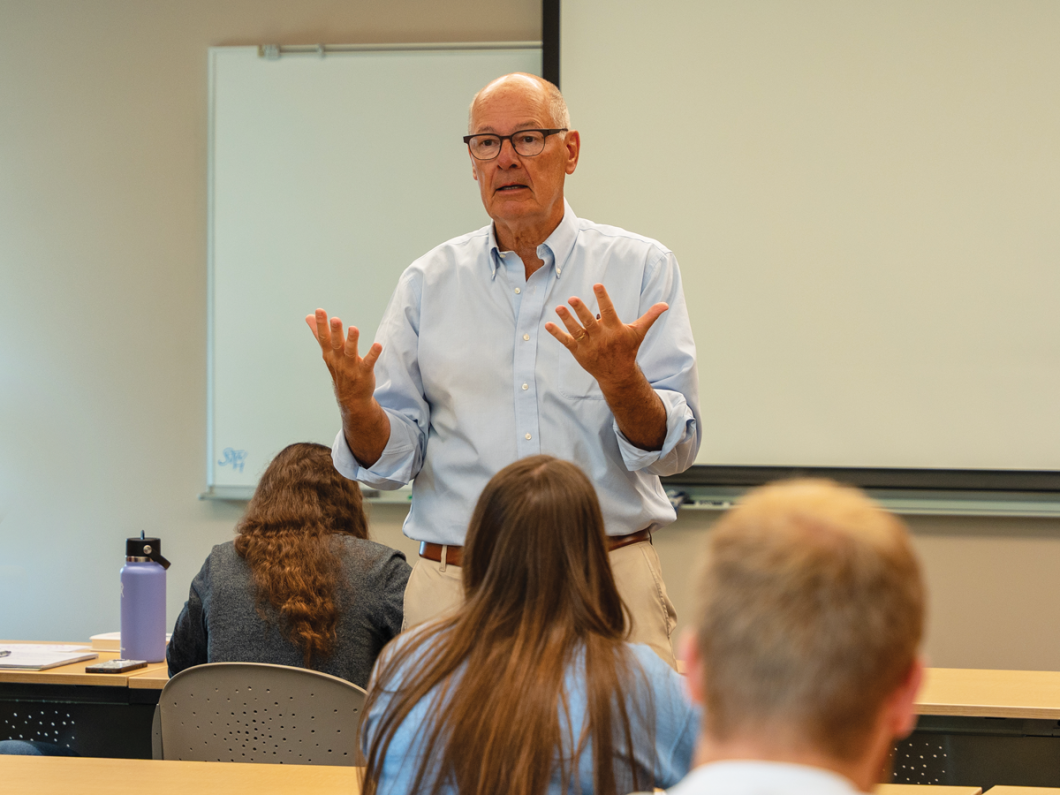
A veteran journalist returns to his alma mater to help students explore “the engine revving inside you”
After more than 30 years as a familiar face on U.S. morning and evening network news, television journalist Harry Smith announced his retirement in March 2024. In a farewell on the Today Show, viewers were treated to a retrospective of his compelling storytelling (driven by his own curiosity) that took his audiences to all corners of the world.
Soon after, he was honored with the prestigious Edward R. Murrow Lifetime Achievement Award.
How do you top such a storied career?
Smith had some ideas. One was to teach. So, he returned to his alma mater, Central College in Iowa, U.S., in the fall of 2024 to teach a course on curiosity.
While he was at NBC, he often mentored new hires and he taught a course on writing.
“Over time, I saw that a lot of kids coming out of college were missing things in their toolkits,” says Smith. “To me, curiosity is number one. And that goes along with adaptability, how to be a sponge, and mindfulness without meditation. These are attainable, teachable skills.”
The two-credit, pass-fail, seminar-style class features readings, guest lectures, and mandatory participation—no phones or screens allowed. Smith says one of his goals is to help young people understand that “your professional and personal life are journeys. You are going to fall on your face; you are going to experience failure.” In other words, Smith says the course explores “all those things that are not in the HR [human resources] manual.”
While he acknowledges there is plenty of literature and theory on curiosity, he breaks it down to two different kinds. There is extrinsic curiosity, which he says is transactional—driven by grades or rewards. The other is intrinsic—curiosity because “you’re just purely interested,” he says.
It was intrinsic curiosity (or as Smith calls it, “the engine revving inside you”) that drove his travels around the world to deeply connect with and tell stories of everyday people doing extraordinary things. Stories, he says, that show “there is more that unites us than divides us.” On that note, he recommends David Brooks’s How to Know a Person: The Art of Seeing Others Deeply and the Art of Being Deeply Seen to his students and others.
Gracie Hoffman took the class last fall. After graduation, she was accepted into a doctoral program in biomedical and translational science. Smith was one of the people she texted with the good news.
“Taking his class has impacted me in so many ways,” she explains. “I’m very goal oriented. I take the quickest road and nothing gets in my way. [But] Harry told me it’s OK to tap the brakes every once in a while. Now I have a garden and I made some pickles. I see how that’s just as beneficial as the big thing. It also made me more open-minded to other people. I now think to myself, ‘How can I better understand who you are and where you are coming from?’”
Ultimately what Smith wants for all his students is to see that “life is a blast. Don’t live in a silo. Get out there and see what’s going on.”
Curiosity in Practice: Creativity, New Ideas, Greater Engagement at UVA
About the author(s)
Tags
Article appears in:

September - October 2025
A SENSE OF WONDER: How curiosity sparks creativity, new ideas, and engagement in the workplace.
Plus advice for mid-level managers, productivity tools to plan meaningful alumni events, and what's next for the future of advancement.