The Power of Giving Together
When Amanda Yanowski joined the advancement team at the University of North Texas (U.S.) in 2018, she was just in time for the big reveal of the first project funded by the newly-formed Diamond Eagles Society. The group of 77 founding members had pooled their gifts of $1,000 each and voted to fund the Diamond Eagles Family Patio.
“I thought ‘Wow, this is innovative,’” recalls Yanowski, Executive Director and Chief Communications Strategist. “I was particularly excited by the appeal of knowing where your dollars go. I loved the idea of mission-driven giving, and this level of direct engagement in giving.”
With a gift of $1,000, a donor joins the Diamond Eagles Society—a collaborative network that chooses, through majority vote, a high-impact campus project to fund. Part venture capital and part Shark Tank, groups across campus have the opportunity to submit proposals and directly pitch their cause to the group.
UNT is a public research institution with 46,000 plus students—the largest university in the Dallas-Fort Worth area. The Diamond Eagles Society was founded in 2017 by Debbie Smatresk, wife of then-University President Neal Smatresk (who served from 2014 to 2024), and alumna Cathy Bryce, with the goal of funding projects that would directly meet worthwhile campus needs.
“When we started Diamond Eagles, the idea was simple: What could happen if a group of people came together, each bringing a meaningful gift and a shared belief in UNT?” says Bryce, a UNT System Regent. “What’s been remarkable is how the idea has grown into something that not only funds important projects, but connects people in a way that keeps them engaged year after year. It is a community of engaged supporters and a giving society rooted in shared purpose.”
Since that first reveal in 2018, the funded projects have made a lasting impact on UNT’s academic enterprise as well as its student life.

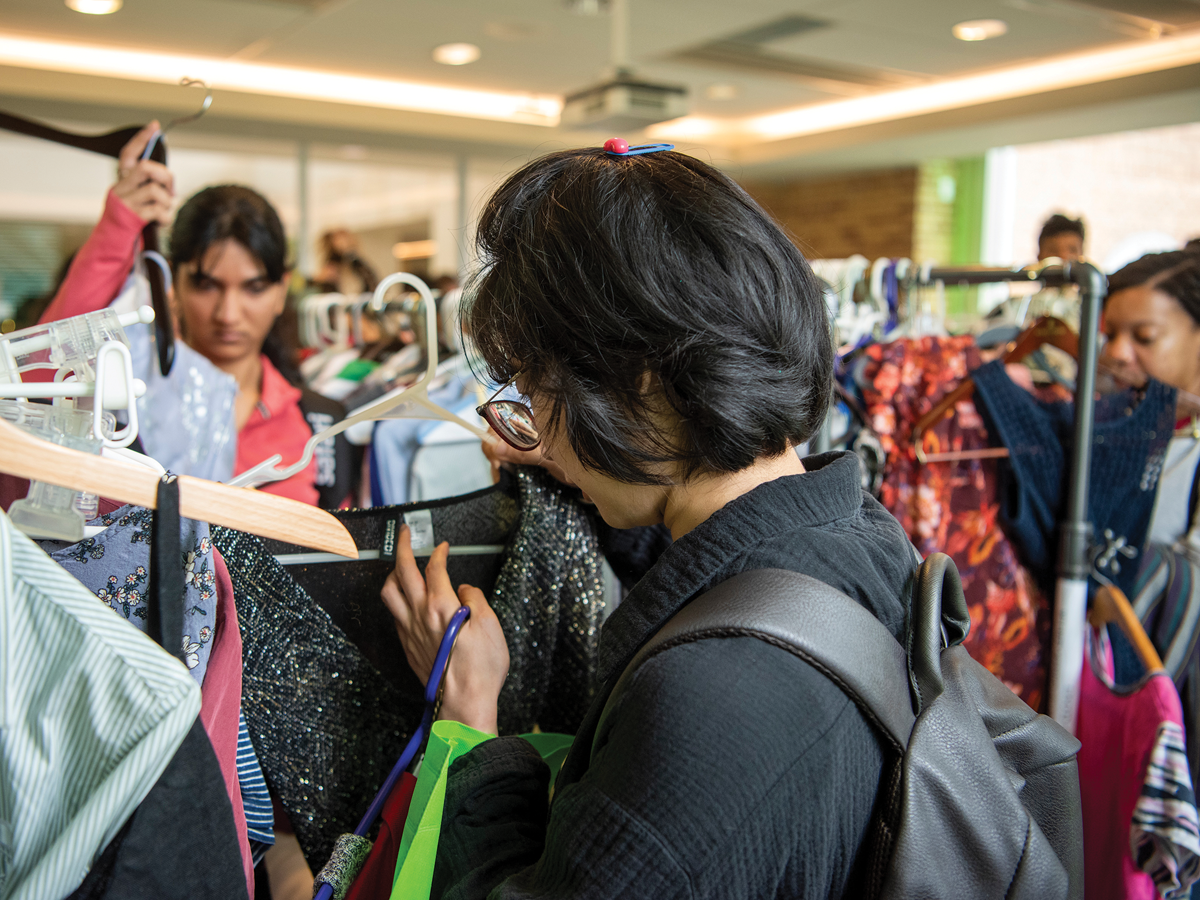
The gift to fund the Diamond Eagles Family Patio was followed in 2018 with a gift that directly and immediately brought relief to students in need. That year, society members voted to use their pooled $90,000 gift to expand the Students of Need: Suit Up, Fuel Up, Cap Up. The Student Affairs-sponsored program provides professional clothing for students who are interviewing or have internship positions, a food pantry for students dealing with food insecurity, and caps and gowns for students who are struggling with graduation expenses.
“Talk about immediate and direct impact! There’s nothing like seeing the emotion from students who benefit from these programs,” says Tristan English, Senior Director of Development, Leadership and Annual Giving.
Since those first two gifts, the Diamond Eagles Excellence Fund has supported:
- digitizing the College of Visual Arts & Design’s Texas Fashion Collection of 20,000 historic and designer garments;
- repurposing a trailer into a mobile production unit that allowed students to bring live events to the homes of fellow students, alumni, and friends of the university during the COVID-19 pandemic and beyond;
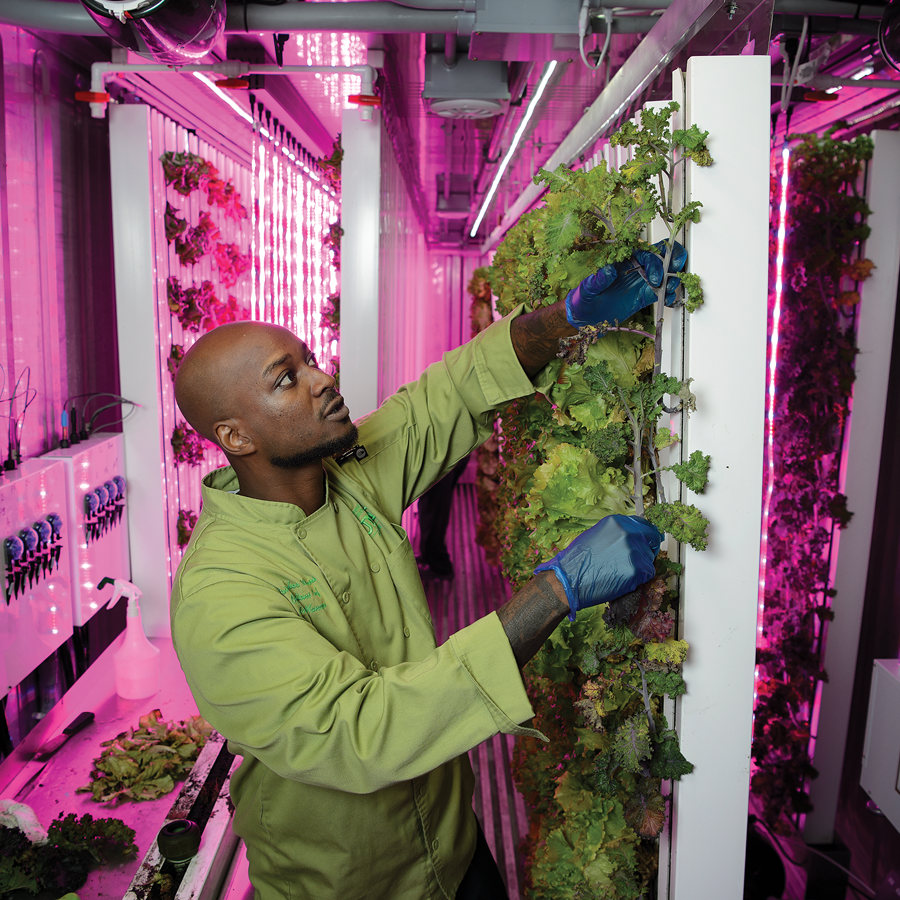
- expanding and relocating the Dining Services hydroponic farm, which increases access to locally grown food;
- building the Diamond Eagles Community and Learning Area through the university’s Pecan Creek Pollinative Prairie program at UNT’s Discovery Park Campus; and
- supporting UNT’s transportation program for students with intellectual disabilities with a new accessible van, among other initiatives for these students.
Most recently, in 2025, the Diamond Eagles Society voted to support the UNT Drone Mapping Program within the Department of Geology and the Environment by providing funds to purchase a government-approved drone system.
The direct benefits to beneficiary programs are clear. But ripple effects across campus and for the donors themselves continue to account for win-win scenarios, say Yanowski and English.
“When this group gathers, this is a really connected room,” says English. “They come together with a shared passion for UNT, and from that common ground, you see all kinds of networks developing and growing. Especially for younger people. Imagine you are in your 30s and for $83 a month, you’ve gained a network of individuals that will help you grow not just your career, but your own passions in life. New friendships are constantly forming.”
Raising awareness is yet another benefit tied to the Diamond Eagles Society, says Yanowski.
“I love educating our donors on all the great things happening at UNT. For instance, people who might be interested in food insecurity programs didn’t know we have a food pantry. Or others with an interest in fashion and history, didn’t know anything about the fashion collection project, and now they are online viewing photos. We are shining a light on so many amazing initiatives.”
“And likewise, there is a heightened awareness on the value of advancement to the university,” adds Yanowski. “We’ve seen the quantity and the quality of the submissions improve as more faculty and staff members have come to appreciate the value of donor support.”
“This has been a gateway for donor opportunities,” says English. “Those proposals that didn’t get funded through Diamond Eagles still gained visibility and often get funded by some of our major donors. And we have major donors become members of the society because they love the model.”
“When I think about CASE [alumni engagement] metrics showing the relation between engagement and giving,” says English, “this is an excellent example of how this relationship plays out in both directions. This is proving to be a nice bridge from annual giving to larger gifts.”
An element of the program’s success is the advancement team’s flexibility as the program evolves.
“We’ve gone through several iterations of the voting process and how we bring the members together,” says Yanowski.
When the program was first introduced, UNT held two major events per year for it: a fall event for program hopefuls to pitch projects, and (after Diamond Society members voted online) a spring event to announce the winning project. A few years later, the UNT team introduced a shorter voting window with one pitch event. The winner was announced via email within a week.
In November 2025, for the first time, proposals and presentations were made at a dinner event with live voting, and the winner was announced that same night. (Those unable to attend received proposals in advance with the option for online voting.)
“It worked really well,” says Yanowski. “This format generated a new level of excitement with a very clear timeline. And although we went to one major event, we keep touchpoints going throughout the year, including a fun summer event allowing members to connect and, hopefully, renew their membership for the coming year.”
Voting may well be the core of the Diamond Eagles Society.

“I find what energizes everyone the most is the opportunity to have a say in where the funds go,” says English. “I think we all see that desire more than ever in this post-COVID era. During the pandemic, donors felt a strong need to give hyperlocally and with immediate impact—[for instance,] that food pantry down the street helping parents who could no longer work. Where is there a great need and how can I make an immediate impact? Every single one of these [Diamond Eagle] gifts changes lives and is built around community, and that’s how we meet donors where they are today.”
Tips for Success
Thinking about starting a similar giving society at your institution? UNT’s Tristan English and Amanda Yanowski share these pointers.
Make sure everyone is on equal footing when submitting proposals. “We provide coaching to help them get at the heart of their ask. Our communications and annual giving teams provide feedback on the length of the presentation, and we look over written and video materials to make sure they are concise and easy to understand.”
Focus on stewardship. “This is essential. Stay connected to winning projects and provide members with updates, focusing on impact. When possible, we incorporate funded projects into events for Diamond Eagle Society members, such as walking tours of the pollinated prairie site or serving food at receptions from the hydroponic farm.”
Cultivate passionate volunteers who can help drive the program. “The heart and soul of the program are community volunteers. Our program started with chairpersons Debbie and Cathy, who are deeply passionate about the UNT community and understand the power of philanthropy. They opened up their contact base to get this off the ground.”
Get buy-in from senior leadership and deans to launch the program. “Our advancement vice president took time to include his fellow members of the president’s cabinet in developing the society. We reached out to deans to fully explain the society and continue to require their approval on proposals that come from their programs.”
Find an amount that works for your community. “For UNT, $1,000 feels right. If we went down to $500, it would have felt too cumbersome to generate the same amount of income. And if it was more than that, we felt we would be going back to the same well of established donors.”
Create great branding and marketing for program recognition and continued growth. “Our materials always include reminders for members to invite others from their networks to join the society or simply to come along to an event to learn more. Our collateral material is also designed to be helpful to annual giving officers who are inviting prospects to become members.”
About the author(s)
Tags
Article appears in:
July - August 2026
HELP YOUR TEAM FLOURISH: Solving talent management challenges today, from growing a team, to recruiting better, to doing more with less. Plus why listening should shape strategy, how alumni can support international students, what makes a giving society work, and more.