

Keynote Speakers

Amanda Litman
Amanda Litman is the co-founder and president of Run for Something, which recruits and supports young, diverse progressives running for down-ballot office. Since launching on Inauguration Day 2017, RFS has built the largest progressive candidate pipeline in the country, electing more than 1,650 leaders across nearly all 50 states — mostly women and people of color. She is also president of RFS Civics, a 501(c)(3) focused on ending the gerontocracy in American politics.
She is the author of two books: When We're in Charge: The Next Generation's Guide to Leadership (Zando/Crooked Media Reads, 2025), named a best business book by the Financial Times and endorsed by Adam Grant, Ilana Glazer, Jon Favreau, and Anne Helen Petersen; and Run for Something: A Real-Talk Guide to Fixing the System Yourself (Atria, 2017), with a foreword by Hillary Rodham Clinton.
Before launching Run for Something, Litman served as National Email Director for Hillary Clinton's 2016 presidential campaign, where she oversaw a digital fundraising operation that raised $330 million from more than 3 million donors. She previously served as digital director for Charlie Crist's 2014 Florida gubernatorial campaign and deputy email director for Organizing for Action. She holds a B.A. in American Studies from Northwestern University.
Politico named her one of 50 ideas driving American politics (2018). Bloomberg named her one of the people to watch (2019). Fortune included her on their 40 Under 40 list (2020). She was named to Time's Next 100 in 2022, was a 2022 Dial Fellow at the Emerson Collective, and is a 2025/2026 Obama Foundation USA Leader.
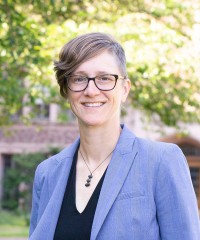
Kate Starbird
Kate Starbird is a Professor at the Department of Human Centered Design & Engineering (HCDE) at the University of Washington (UW). Kate’s research sits within the fields of human-computer interaction (HCI) and computer supported cooperative work (CSCW). Extending from early work in crisis informatics, her research program has followed the phenomenon of online rumoring down the rabbit hole and into some of the toxic online spaces that are increasingly (re)shaping discourse, values, and politics around the world. In particular, Kate’s team has developed and deployed methods for conducting rapid research to help resolve rumors as they unfold. Another major contribution of her work has been to demonstrate that online disinformation — i.e. the intentional manipulation of discourse for political gain — is inherently participatory, taking shape through collaborations between witting agents and unwitting (though willing) crowds. Most recently, her research has converged on a conceptualization of right-wing media as effectively leveraging partisan, participatory dynamics through improvisational performances.
Dr. Starbird received her BS in Computer Science from Stanford (1997) and her PhD in Technology, Media and Society from the University of Colorado (2012). She has received several awards for her research, including the ACM SIGCHI Societal Impact Award and a Presidential Early Career Awards for Scientists and Engineers (PECASE) award. She is a co-founder and formerly served as director of the UW Center for an Informed Public, which works through research, education, and policy recommendations to strengthen democratic discourse by building resilience to online misinformation, propaganda, and manipulation.

Richard Yonck
Richard Yonck is an international keynote speaker, global futurist and best-selling author. Recognized globally for his ongoing research at the nexus of artificial and human intelligence, Richard has been helping audiences and businesses better understand the implications of exponential progress for decades—all while asking the question: What kind of future do we really want? He’s explored emerging trends and developments with businesses and organizations all over the world, including global Fortune 500 companies such as Amazon, Microsoft, Samsung, and Xerox, industry associations, as well as government agencies and NGOs, including UNDP and NATO.
Richard’s widely acclaimed book, Heart of the Machine studies the future of the emerging technologies that allow computers and robots to read, interpret, and influence human emotions. Now in its second edition, it’s been translated into multiple languages. More recently, Future Minds explores the nature and future of human and artificial intelligence. Mindstock, published in 2025, is a novel about the future of AI and media in a post-truth world.
Richard writes for the technology news website GeekWire and has been published by and quoted in The New York Times, Wall Street Journal, Scientific American, Forbes, Wired, Fast Company, BBC News and many others. He’s a member of the Association of Professional Futurists, the National Association of Science Writers and a TEDx speaker.