
An Optimized Segmentation Model
From the Nominator
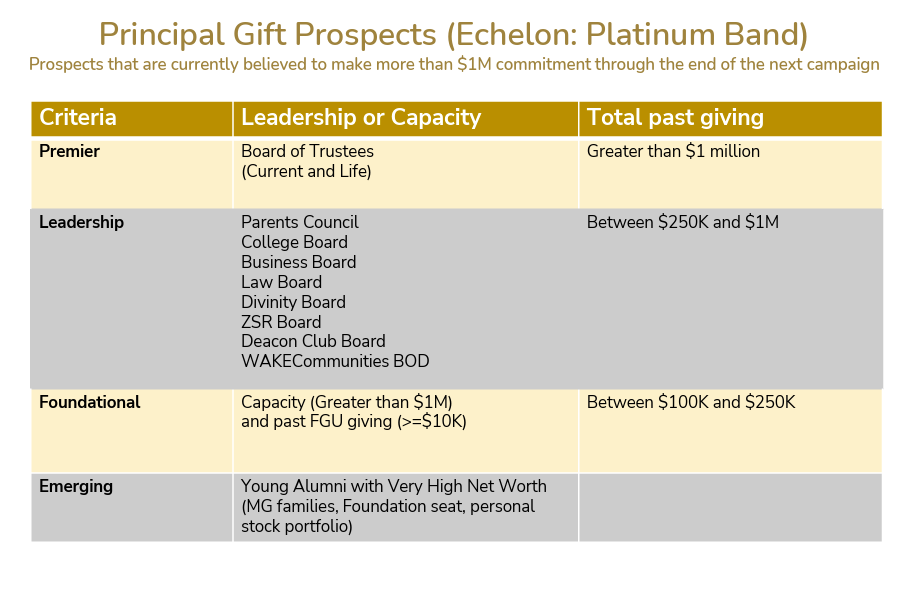
The goal of Wake Forest's Echelons initiative was to create a framework for segmenting and prioritizing major and principal gift prospects and supporting more confident prospecting, qualification, and portfolio management. Traditional prospect rating systems, built primarily on RFM (recency, frequency, and monetary value) metrics, often favor alumni and long-term donors, while unintentionally overlooking constituencies with shorter relationship windows, such as current parents and young alumni. Because parent engagement is inherently brief, many parents experienced declining RFM ratings, despite having strong philanthropic potential. As a result, large portions of the parent pool remaining uncontacted. To address this challenge, we developed Echelons, a segmentation framework that groups major-gift prospects into dynamic bands—platinum, gold, silver, bronze, and copper—based on attributes most predictive of giving. Rather than relying solely on philanthropic capacity and attachment, Echelons integrates interaction data and other contextual indicators and evaluates prospects at the group level. This approach allows prospects like current parents with limited giving history but strong readiness signals to be fairly evaluated alongside well-engaged prospects. The framework restored clarity to a large and complex major-gift universe. Following deployment at the start of fiscal year 2025, parent commitments increased 147% and commitments from current parents grew 40%.
From the Judges
This submission recognizes a fundamental bias in traditional prospect models and takes a smart, data-informed approach to address it. By accounting for unequal engagement histories, the Echelons model brings greater equity, clarity, and intentionality to major-gift prospecting, particularly for constituencies such as current parents. The framework is creative, useful, and grounded in the realities of the institution’s constituent population. The significant increase in parent commitments demonstrates the value of rethinking legacy models and applying existing data in a more effective way.