
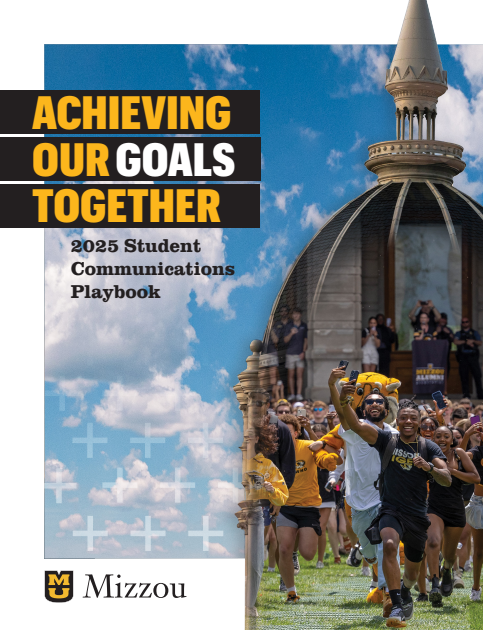
2025 Student Communications Playbook
From the Nominator
The Student Communications Playbook from the University of Missouri-Columbia was designed to shift institutional assumptions about student communication. The playbook organized and prioritized communication with students, empowered divisions to communicate effectively, and reduced competition for students' attention from recruitment through graduation. Begun in 2023 to create a framework for student recruitment, we expanded the playbook in 2024 to include student affairs and academic success. The 2025 playbook was released in June 2024 to support the fall 2025 cycle. With strong partnerships across the university and an unrelenting focus on improving the student experience, the fundamentals of our playbook came together: 1) Organize and share institutional communication plans and tactics for three goal areas: recruitment, onboarding, and retention; 2) Define which level of the university is best suited for every type of communication--institutional voice, unit voice, or individual voice; 3) Create and share tools that empower units to define which parts of the institutional goals they can own, so they can leverage their strengths and optimize their time and investment; and 4) Organize and share unit communication plans to identify gaps, redundancies, conflicts, and opportunities. Changing the way our institution thinks about communication with students is a slow ship to turn, but we're making progress. Our approach has resulted in greater student compliance, reduced student email volume, improvements in student engagement and a sense of belonging, and record applications and student retention rates.
From the Judges
The University of Missouri–Columbia was recognized for its refreshing take on effective, cross-institutional communication with students. Placing students at the center of a strategic communication reorientation, the messaging practices and platforms of nearly 60 offices were examined, resulting in improved communication. In some cases, a 90% reduction in emails led to an increase in student completion/compliance responses. Results included an 87% drop in registration holds, a nearly 800% uptake in hazing prevention training, and an approximately 5% greater completion of immunization records. The effort led to clear benefits: applications (+13%) and enrollment (+16%) increased, and first- to second-year retention rose to a record level. We applaud this entry from the University of Missouri–Columbia and commend it to all institutions as an example of how streamlining and reducing communication bloat can lead to many positive outcomes.