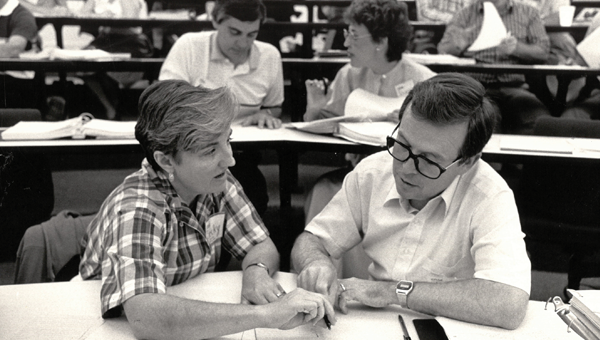
When Karen E. Osborne first started working in development in 1982, she’d wake up early to exercise before work. Because from the moment she walked into the office, colleagues came to her with so many questions she hardly had a moment to sit down.
Realizing she had a lot to learn, she headed to a CASE conference.
“Up until then, I didn’t know I belonged to a profession,” says Osborne. “Going into that CASE conference so early in my tenure, I met all these people who were jazzed about philanthropy and proud of being fundraisers.”
That, she says, sold her on the profession—but also on CASE’s learning opportunities. Osborne (then Director of Corporate Relations at Rensselaer Polytechnic Institute in New York, U.S.) went on to be one of CASE’s longest serving volunteers, presenting at programs like the Summer Institutes, Minority Advancement Institute, CASE Academy, and more.
Throughout CASE’s 50 years, advancement professionals like Osborne have turned to CASE for professional learning and found, in addition to best practices, a network of colleagues and mentors. CASE’s educational programs have over time expanded globally, attracted more participants, and explored trends and ideas—all with the signature CASE sense of community and connection.
The CASE DNA
CASE held its first Annual Assembly—which would become the Summit for Leaders in Advancement—in 1975 and announced a slate of nine conferences, including programs on government affairs and managing alumni programs. The July 1977 issue of Currents reported that conferences and learning opportunities were “the council’s most valuable single service” according to members.
Today, CASE’s more than 70 in-person conferences and online trainings, seminars, and courses serve thousands of advancement professionals. A CASE program is “a space to learn and network with colleagues, where [advancement professionals] feel that they are not alone. They can share challenges and successes; they have the potential to connect with others and learn,” says Angélica Careaga, Executive Director of Latin America.
Early on, CASE zeroed in on a conference model that’s still used today. Advancement practitioners serve as volunteer faculty, working with staff to develop programming with an “emphasis on getting together, learning from and teaching each other,” writes Rob Moore in the book CASE at 50. “This formula, deeply embedded in our DNA, plays through all CASE conferences and workshops throughout the world.”