
“You say Kent State, even today, and most people have an idea of what that means. It might not be accurate, but it definitely is about 1970,” said Stephen Ward.
Ward, Vice President, Communications and Marketing at the Ohio, U.S., university, is referring to the anti-Vietnam War rally on May 4 where the National Guard shot and killed four college students.
In 2023, he set out to create “Legacy: May 4,” a documentary audio podcast capturing the story of the event, while showcasing how the university has grown since then.
Before Ward started the process, he reached out to alumni who were there, including Chic Canfora whose brother, Alan, was shot. He noted that this was “the person who was most important to me,” as she’s one of the top activists around the event.
“There’s a lot of sensitivity about how the story is handled, how it’s told accurately,” he said, adding that even today there’s extra sensitivity surrounding the university’s administration telling of it.
The four-part podcast, released the week of the 54th anniversary, not only covers the event, but the context surrounding it, including what it was like to be a student in the 1960s and 1970s and how President Nixon responded. Archival audio pulled from Kent State’s library, music, and new interviews combined to provide the content.
Other events—including the Oct. 7, 2023, Hamas attacks on Israel—influenced his content as well. In the first episode of the podcast, Ward shared as campus protests started to spread after Oct. 7, the university started to get media calls.
“Even today, there’s an attempt by national media to relate current events on campuses with what happened at Kent State,” said Ward. While protests did occur on campus, he noted that students responded with kindness and respect—values that are part of the legacy of May 4.
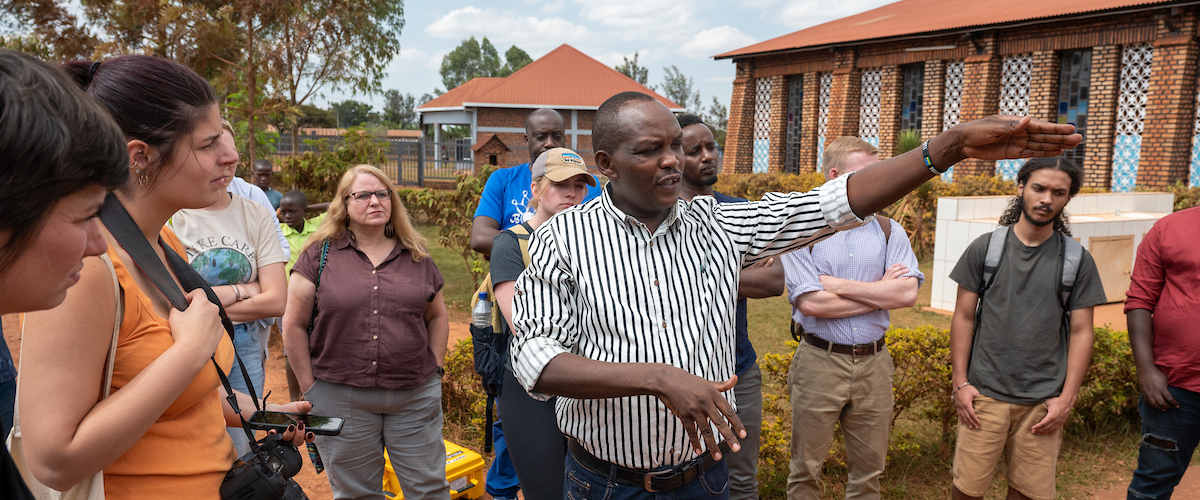
He also tied in how the impact of the event has shaped Kent State: its School of Peace and Conflict Studies was founded in 1971 in the wake of the shootings. Today, the school is central to the university’s global presence and is involved in Rwanda and Brazil. Ward dedicated an episode of the podcast to discussing these partnerships, even traveling to those locations to conduct interviews.
Ward used a desktop soundproof booth and a portable digital recorder to record his voiceover, writing the script around the audio elements. While he had help building the website and graphics for the series, he created the podcast on his own.
The podcast had a 62.5% engagement rate through its homepage and the completion rate, or time spent on each episode, was between 85% and 100%.
Ward hopes that, although the story has been told many times in different formats, it might offer a new perspective and that listeners might get something new out of it, especially because it covers what the university is doing today.
In 2025, he led a session at CASE’s District V Conference in Chicago, Illinois, U.S., titled “Leading with the Legacy of Tragedy” where he shared how the university incorporated lessons from its past, such as May 4, into its brand messaging. It ended up bringing a full room of people who also have a campus tragedy in their history.
“Many of them sa[id] they also try to find ways to demonstrate how what they learned through tragedy is living in their university today,” he said, “It was great just to compare notes on that, essentially.”
Attendees found the session to be fascinating, thoughtful, and reflective, with one noting “this was my favorite presentation at this conference.”
In 2025, the podcast received a Grand Gold Circle of Excellence Award, with judges noting that it “goes beyond a simple history lesson and ties into what is happening today, creating an engaging experience that stands on the strength of its audio storytelling and archival content.”
About the author(s)
Tags
Article appears in:
April - May 2026
DIGITAL-ONLY ISSUE: Giving through, not just to: transforming philanthropic messaging. Plus the latest in naming rights, how investing in students today sets the foundation for alumni engagement, rewiring giving through high-impact funds, and more.