
Some of you have seen my presentation at district conferences on why and how to build a culture of philanthropy at your community colleges. In January, Gretchen Wood, Vice President of Institutional Advancement and Executive Director of the Monroe Community College Foundation (New York, U.S.), Lindsey Bogner, Executive Director of Institutional Advancement for the Barton Community College’s Foundation (Kansas, U.S.), and I talked more about it during a well-attended webinar, which you can watch here. I’d like to dig into it a bit here because, as advancement leaders at your community colleges, building this culture is critical—and, for many of you, it doesn’t exist.
When I worked at a community college, most of the staff and faculty knew our foundation raised money for scholarships. A few may have even known that there was a foundation board of community leaders who helped. The annual spring scholarship reception was a nice opportunity for our scholarship winners to meet those who contributed to the scholarship fund. And every November, we’d humbly ask employees to consider a gift to the foundation to help the scholarship program, and that gift could be conveniently made through payroll deduction. This, friends, is not a culture of philanthropy.
In a culture like that, the advancement staff—which may just be an executive director and one or two others—feel very alone. If they’re lucky, the college president helps secure major gifts, but most fundraising efforts and staff time are typically focused on special events. So how do you develop a culture that “fosters relationships that share a common understanding, appreciation, and responsibility for the importance of the joy of giving and receiving for the enhancement of the institution,” as defined by the CASE research department in a 2013 Currents article? The steps are easy and somewhat commonsensical, but they take time, patience, and proactivity—a perfect example of the “endurance leadership” requirements noted by Holyoke Community College’s (Massachusetts, U.S.) Amanda E. Sbriscia in her recent Currents article.
First, consider the key players on your campus: advancement staff, college staff, leadership, boards, students, and faculty.
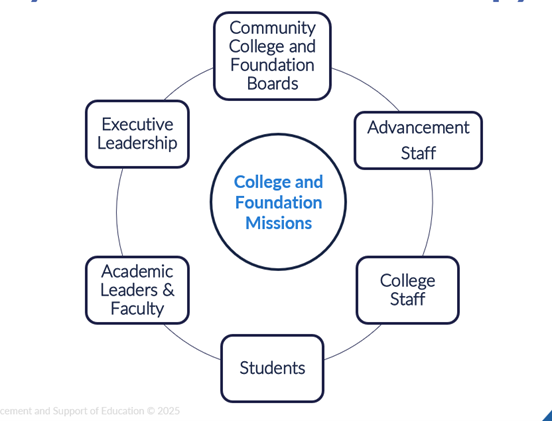
Note that I placed the college and foundation’s mission in the middle of this image. Do the six groups of key players know your foundation’s mission and how it connects to your college’s mission? There’s no need for any mission memorization here—everyone on your campus should simply understand why the foundation exists and how they can help you. Let’s take a quick look at how you can help each group do that.
Advancement Staff: Start here to build your confidence. Treat your staff to coffee or lunch to discuss the foundation’s mission, compare it to the college’s mission, and discuss how important their work is to fulfill the missions of both organizations. Explain how every interaction with prospects and donors—internal colleagues and external community friends—is critical to the ongoing development of their relationship with your institution. (That’s why we call it development!) At a future meeting, invite a scholarship winner to join you so your staff can easily answer the “why” of what you do.
Foundation and College Boards: Your foundation board members should learn the mission of both the college and foundation as part of their recruitment and onboarding processes. But, at a foundation board meeting, take a moment to reflect on the missions and discuss how your strategic fundraising plans stem from them. Invite a student or faculty member who benefited from your foundation’s work to a foundation board and college board meeting so they can further explain the impact of fundraising efforts. Make sure every trustee has easy access to a dashboard/data with a top-level view of how much has been raised and awarded and for what programs/services. They should also have a simple to-do list of ways they can help you. This could include attending a fundraising event and bringing two friends; setting up a campus tour and meeting with a person of influence and affluence, the college president, and you; and attending commencement. Do you have a foundation trustee as an ex officio member of the college board? This helps build trust, communicate fundraising priorities, and develop a “we’re all responsible for the college’s fundraising success” spirit.
College Staff: They have enough to do as they process student financial aid applications and registrations, keep the campus grounds safe and clean, run various services like student food banks, and solve transportation issues; those who work at community colleges are there to help everyone and probably don’t get paid very much for their hard work. Make a point of visiting their department meetings and getting to know them. If you hear about a staff member who spends extra time to help a student, send them a note or drop off a cup of coffee so they know you noticed—and care. Become a regular guest at union meetings (at my school, we had a union for everyone from the campus police to faculty to professional staff!) so you can hear about their concerns, and you can share good news and your goals with them. Remember, this is about building a relationship, not making an ask. (For now.)
Students: Yes! Students are definitely key players in your culture of philanthropy. Those who receive financial assistance through the foundation should help you at your events, speak at the meetings I mentioned above, and serve as advocates for your work and as cheerleaders for your institution wherever they go. At their jobs, gyms, coffee shops, and everywhere on social media, students should share how much they love(d) attending your school and are doing well thanks to what they learned there. Scholarship recipients should have some college swag (could your foundation invest in T-shirts or hats for them?) and wear it proudly. Meet with student leaders and student organizations to learn more about their interests. Is community service part of their mission (for example, check out Phi Theta Kappa’s goals)? Perhaps they could fundraise for a foundation program and/or help at an event or serve as ambassadors when you give a campus tour to a prospect.
Academic Leaders & Faculty: Did you read “Advancement 101” in the Jan/Feb edition of Currents? It’s so important to motivate faculty and staff to build a culture of philanthropy that some schools have created a seminar to identify campus champions and teach them about advancement. If you don’t have the time or staff to create a Certified Advancement Partner Program like the one at Miami University in Ohio, U.S., attend academic department meetings and faculty association meetings to share how your foundation has helped students and academic programs. Find a faculty champion who can persuade others, peer to peer, about the importance of supporting your efforts. Have you received a grant for a new piece of equipment and/or set up a partnership for specialized training through your workforce development department? Get out there and talk about it! Celebrate the win in person, not just in a campus newsletter or social media. Break down those silos and show how teamwork benefits the whole campus community.
Executive Leadership: Let me guess—this group considers you The Fundraiser. Period. How do you persuade them to embrace your foundation’s mission? The first thing to do is to make sure you are a member of your college president’s leadership team. In a recent CASE survey among some of the most successful two-year fundraising programs, 91% of the chief advancement officers/executive directors reported serving on their college president’s cabinet. You need to be in the room where it happens. You must regularly hear about the resources that are lacking across campus from those in charge and help to build strategies to fulfill those needs. Even if you aren’t on the team, set aside time to meet with each cabinet member several times throughout the year, and you should have a standing monthly meeting with your president. Listen to their priorities, share yours with them, notice alignments, and fix misconceptions. Be proud of what you do and show them the difference you and the foundation are making every day at your school.
Have you noticed who I didn’t include in my list of key players needed to build a culture of philanthropy? Alumni. If you read my December column, you know that I get nervous when I meet community college advancement leaders who are spending a lot of time and resources on alumni. If you have the money to hire a staff member to focus on alumni, go for it! But for the small shops out there, you need to work smarter, not harder, especially when records of those who graduated and completed all kinds of non-credit courses are messy. Alumni should, of course, be your biggest cheerleaders in your communities and wherever they may go if they leave your area. Let’s consider them the icing on the cake of a culture of philanthropy—but I believe your energy is better focused on the key players here who are the main ingredients of the cake.
I have many more ideas for cultivating each group—please reach out if you’d like me to meet with you and/or your staff or key volunteers to discuss. Referring to Amanda Sbriscia’s article again, development work is a marathon, not a sprint. It should take a few years of relationship-building to create an effective culture of philanthropy. But every minor or significant interaction, every friendship built, every alliance made is so worth it!